|

|
|
Skyscrapers & Commercial Buildings
Tour Overview
Detroit is well known for
its stunning collection of pre-depression era commercial architecture. Legendary Detroit architects such as Albert
Kahn, George D. Mason, and Wirt C. Rowland collaborated with master
architectural sculptor Corrado Parducci
to shape the Detroit skyline and infuse the city with cultural icons. Amazingly, many of these beautiful
structures remain vacant and have struggled to survive as Detroit claws its
way out of economic decline. As such,
this tour may leave you with mixed feelings.
After all, it includes some magnificent and historic buildings that
simply may not escape the wrecking ball.
But it is reality, and we want you to see both the tragedy of Detroit
and the triumph that is emerging with its revitalization. With Detroit on the rebound, many of these
buildings are being resurrected and restored to their original luster. Detroit is a hidden gem of opportunity just
staring to catch on!
Skip To…
Tour Map
Related Tours
Resources &
Links
|
|
|
Michigan Central Depot [A]
Michigan
Avenue and 14th Street
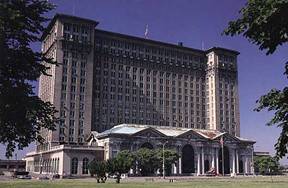
No other vacant Detroit
building has become such a center of attention as the Michigan Central
Depot. The attention is likely due to
the station's monumental but battered architecture. However, if you look beyond the vandalized
exterior and gutted interior, you will find a structure unmatched in the city
in terms of shear magnificence. A few
years ago, the City of Detroit announced it would refurbish the building and
relocate its police headquarters there, but plans were abandoned when the
cost for restoration was determined.
|
Book-Cadillac
Hotel [B]
1114 Washington Boulevard
Website
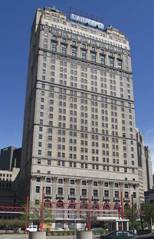
Downtown's largest and
perhaps most beautiful vacant skyscraper is the Book-Cadillac Hotel. Its builders in the early 1900s had a
vision to make Washington Boulevard the "5th Avenue of the
West". The Book-Cadillac and its
rival, the Statler Hotel (now demolished), enjoyed
great success in the 1920s. The
Book-Cadillac offered 1200 guest rooms and some of the most amazing interior
spaces in the city. It is the supreme
symbol of 1920's Detroit's wealth and optimism but eventually fell on hard
times and closed in the 1980s.
Fortunately, investors poured $200 million into this signature
building and it reopened as the Westin Book-Cadillac Hotel in 2008.
|
|
Penobscot Building [C]
645 Griswold
Street
Website
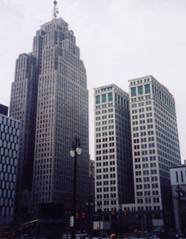
At 566 feet (173 m), the 47-story Penobscot
Building was the tallest building in Michigan from its completion in
1928 until the construction of the Renaissance
Center's central tower in 1977. Upon its completion, it was the eighth
tallest building in the world and the tallest outside New York City and
Chicago. Like many of Detroit's Roaring Twenties buildings, it displays Art
Deco influences, including its "H" shape (designed to allow in
maximum sunlight) and the sculptural setbacks that cause the upper floors to
progressively "erode." At
night, the building's upper floors are dramatically lit in floodlight
fashion, topped with a red sphere. The Penobscot was designed by Wirt C.
Rowland and features architectural sculpture by Corrado
Parducci.
|
|
Guardian Building [D]
500 Griswold
Street
Website
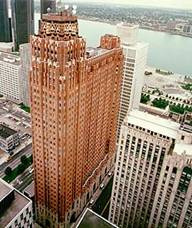
Like the Book-Cadillac Hotel, the Guardian Building is a
testament to the booming, modern city Detroit had become in the 1920s. The Union Trust Company grew to be one of
the largest financial institutions in the city and decided its success
warranted a new building. They hired
Former Albert Kahn and George D. Mason understudy Wirt C. Rowland who
designed this striking addition to the Detroit skyline. The building is colorful inside and out,
with an orange-tan brick covering the exterior and a multitude of granite,
stone, tile, and terra-cotta on the lower floors and interior. The
luxurious interior caused the Guardian Building to quickly become known as
the "the Cathedral of Finance."
|
Wayne County Courthouse [E]
600 Randolph
Street
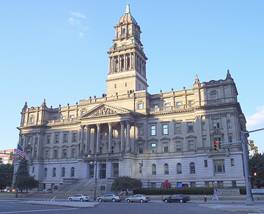
The Wayne County Courthouse is a prime example of growth in
metropolitan Detroit in the 19th century. It also highlights Detroit's present day
resurgence and interest in historic preservation. When built, the courthouse was an elaborate
design featuring a granite and sandstone
exterior with two sculptures of four-horse chariots at the base of the
four-tiered tower. The interior was
similarly elaborate and included marble, mahogany and oak, and mosaics.
The Courthouse served as the center of Wayne
County government from 1900 through the 1950s. After most government offices were
relocated, the facility fell into disrepair.
Fortunately, a private partnership restored the building and reopened
it to the public in the late 1980s.
|
Grand Circus Park [F]
Vicinity of
Woodward Avenue and Park Street
Grand Circus
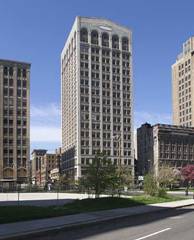
Park has often been called a skyscrapter graveyard. But Grand Circus Park is perhaps the best
place to see Detroit's troubled past giving way to a bright future. Such gems as the Kales Building (an Albert
Kahn design) sat vacant for 20 years.
The building has become an excellent example of adaptive reuse
with its conversion into lofts and commercial space in 2005. With some luck (and a few investors!), many
other office buildings, theatres, and other structures in the Grand Circus
Park area will experience the same rebirth.
Fortunately, the plethora of of entertainment options in this area make it a good bet
that the tranformation will continue.
Grand Circus Park is perfectly situated within a block or two of
Foxtown, the Stadium District, Harmonie Park, and
the Theatre District. You can catch a game at Comerica Park or
Ford Field, live music at the Fox or State Theatres, or a performance at the
Opera House or Music Hall. A number of
popular bars and restaurants are located in this area as well.
|
|
Cultural Center [G]
Vicinity of
Woodward Avenue and Putnam Street
Full Tour Page
There is no better place
than here to explore Detroit's intellectual and artistic influences. Development of the Cultural Center dates
back to 1913 as part of the City Beautiful movement which advocated the
clustering of important public buildings.
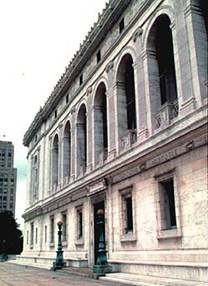
Three buildings make up the core of the Cultural Center -- the Detroit
Public Library, the Detroit Institute of Arts, and
the Horace H. Rackham Education Memorial Building. Since the establishment of these architectural
monuments, the Cultural Center has expanded to include a number of other
museums, galleries, theatres, and attractions, most within walking distance
of one another. In addition, the area
is home to two highly regarded educational institutions, Wayne State University and the College for Creative Studies. The Cultural Center's location two miles
north of downtown along Woodward Avenue.
|
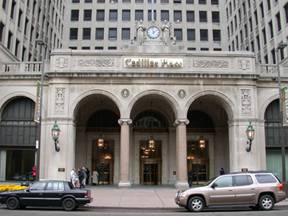
New Center [H]
Vicinity of
Woodward Avenue and West Grand Boulevard
New
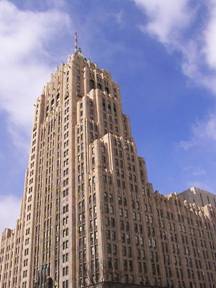
Center is definitely the house that Albert Kahn built! The master designer developed two National Historic
Landmarks here -- the Fisher Building (shown at top of this page) and the
General Motors Building (shown at right).
The Fisher, perhaps the most significant structure of Kahn's career,
houses shops, restaurants, art galleries, business offices and the renowned
Fisher Theatre. The General Motors
Building, also known as Cadillac Place, served as GM's headquarters from 1923
to 1996 prior to relocating downtown to the Renaissance
Center. Consisting of eight wings
projecting from a central spine and a five-story hipped-roof annex connected
to the rear façade, the building symbolized General Motors' dominant position
in the automobile industry.
|
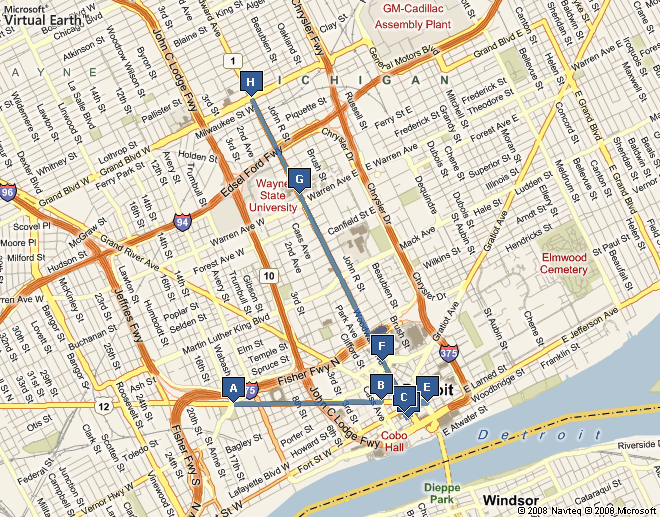
Tour Map
Number of Destinations: 8
Overall Tour Time:
1 day (assumes a leisurely pace and extended stops at several
locations)
|
|
|
Related Tours
Architectural
Tours -- Churches & Cathedrals
Architectural Tours --
Mansions & Great Estates
Architectural
Tours -- Historic Neighborhoods
Automotive
Heritage
Cultural Center
Downtown Detroit
Historic Sites
New Center
Woodward Avenue
Scenic Tours
|
Resources &
Links
Fabulous Ruins of
Detroit
Forgotten
Detroit
HistoryDetroit
Model
D
National Register of
Historic Places
|
|
|
|
|
Back to Top
Home Page
|
|
Copyright
© 2006-2017 SEK Inc.
|