|
EXPERIENCE DETROIT Attractions
& Self-Guided Tours |
|
||||||||
|
|
|
|
|||||||
Architectural
|
|||||||||
|
|
|||||||||
|
|
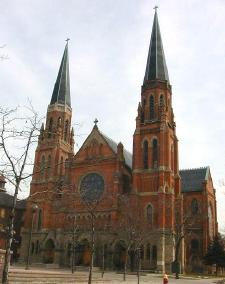
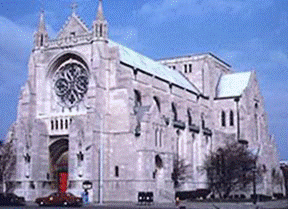
Ste. Anne de Detroit [A]
1000 Sainte Anne Street One
of many fascinating and historic churches in Detroit, St. Anne's is highly
demonstrative of the Victorian Gothic architectural period of the late 19th
century. But Ste. Anne's importance is
defined even more so by its history.
Construction of the original Ste. Anne Roman Catholic Church began a
mere two days after French Explorer Antoine de la Mothe Cadillac's landing in
Detroit in 1701. Due to fires and
urban renewal, Ste. Anne's was re-built eight times in its history. The present Ste. Anne's located near the Ambassador Bridge was completed in 1887. Ste. Anne's is the second oldest parish in
the country with an unbroken history, founded 75 years before the United
States of America came into existence, and is the sole operating entity that
dates to Detroit's founding. The
church's historical records are considered highly significant and
comprehensively document Detroit's evolution from a French settlement
to a British-claimed territory to a U.S. city. |
||||||||
|
|
Fort Street
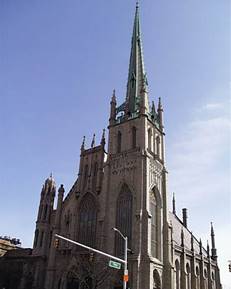
Presbyterian [B]
631
West Fort Street This
National and State historical monument was built in 1855 using limestone from
the quarries of Malden, Canada. It was
designed Decorated Gothic style by architect Albert H. Jordan. The highlight of the exterior is the spire
that rises 265 feet above the street, supported by flying buttresses atop a
tower copied from a 15th century English cathedral in Louth, England. At the time of its construction, Lafayette
and Fort Streets were the fashionable part of the city and it was surrounded
by the stately homes of prominent Detroiters including Russell A. Alger,
James, F. Joy, Theodore S. Buhl, Henry D Shelden, and Zachariah Chandler. |
||||||||
|
|
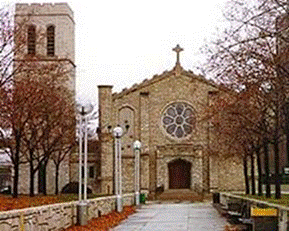
Mariners' Church of Detroit [C]
This rectangular, front-gable Gothic
Revival church with walls of grey, irregularly coursed limestone topped by a
crenellated roofline is the oldest stone church in |
||||||||
|
|
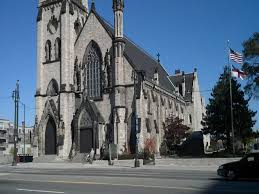
St. John's Episcopal [D]
50 East Fisher
Freeway This Victorian Gothic-style
church was built in the mid-1800s along Woodward
Avenue in an area once known as Piety Hill. At the time, Piety Hill was considered to
be on the "outskirts" of the city but now is very much in the
middle of the action (the church is situated across from the Fox Theatre and adjacent to Comerica
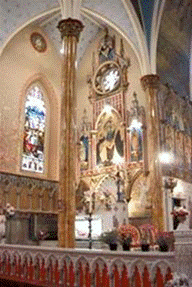
Park). In addition to impressive
exterior architecture, St. John's has beautiful stained glass representative
of a number of different styles. If
time, also check out Christ Church just south of Comerica Park on the same
side of Woodward.
|
||||||||
|
|
St. Albertus [E]
4231 St. Aubin Street When Polish
immigrants came to |
||||||||
|
|
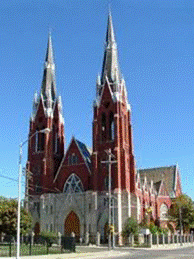
Sweetest Heart of Mary [F]
4440 Russell Street Sweetest Heart of Mary Church was founded in 1886 as a result of dissension within mother parish
St. Albertus and became a cornerstone of the Polish
community in Detroit. This
awe-inspiring church, designed by the architectural firm of Spier and Rohns,
was hailed as one of the most beautiful Gothic structures in the State of
Michigan and as the largest and grandest Polish church in the United
States. It remains a source of pride
and a beacon of faith for Polish Americans in the metro Detroit area to this
day. |
||||||||
|
|
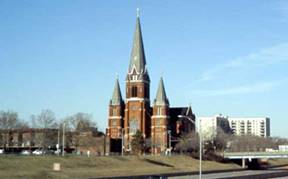
St. Josaphat [G]
St. Josaphat was founded in 1889 with
much-needed additional capacity for the steady influx of Polish immigrants
into the city in the late 1800s. It
became the fourth Polish-speaking parish in the City of Detroit and provided
an alternative to the two bickering Polish-speaking parishes nearby, St. Albertus
and Sweetest Heart of Mary. St. Josaphat
is built in the Victorian Romanesque style with some Gothic and Baroque
details. The expansion of electric
light had great impact on St. Josaphat as is evidenced by all of the sacred
images of the church illuminated by a myriad of tiny light bulbs. |
||||||||
|
|
Cathedral Church of St. Paul [H]
St. Paul is one of the first and finest
examples of the Late Gothic Revival style.
The architect was Ralph Adams Cram, a leading designer of Gothic
Revival churches in the late 19th and early 20th
centuries. Built entirely of limestone, the Cathedral was
not only intended to look Gothic, but it was actually built according to
medieval construction techniques. There is no steel superstructure in the
building, and its enormous weight is entirely self-supported. A Detroit architectural treasure! |
||||||||
|
|
|||||||||
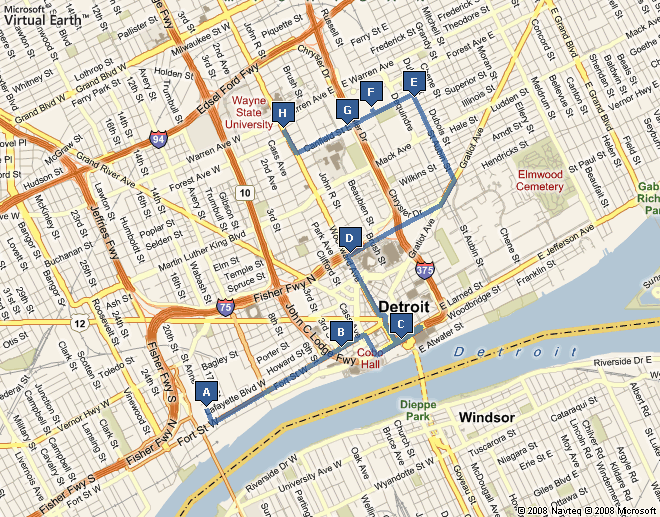
Tour Map
Number
of Destinations: 8 Overall
Tour Time: 1 day (allowing for
extended stops at several locations)
|
|||||||||
|
|
Related Tours
Architectural
Tours -- Skyscrapers & Commercial Buildings Architectural
Tours -- Great Estates |
Resources &
Links
National Register of Historic
Places |
|
||||||
|
|
|||||||||
Copyright
© 2005-2017 SEK Inc.